 Türkçe
 English
 Deutsch
 Français
 Русский

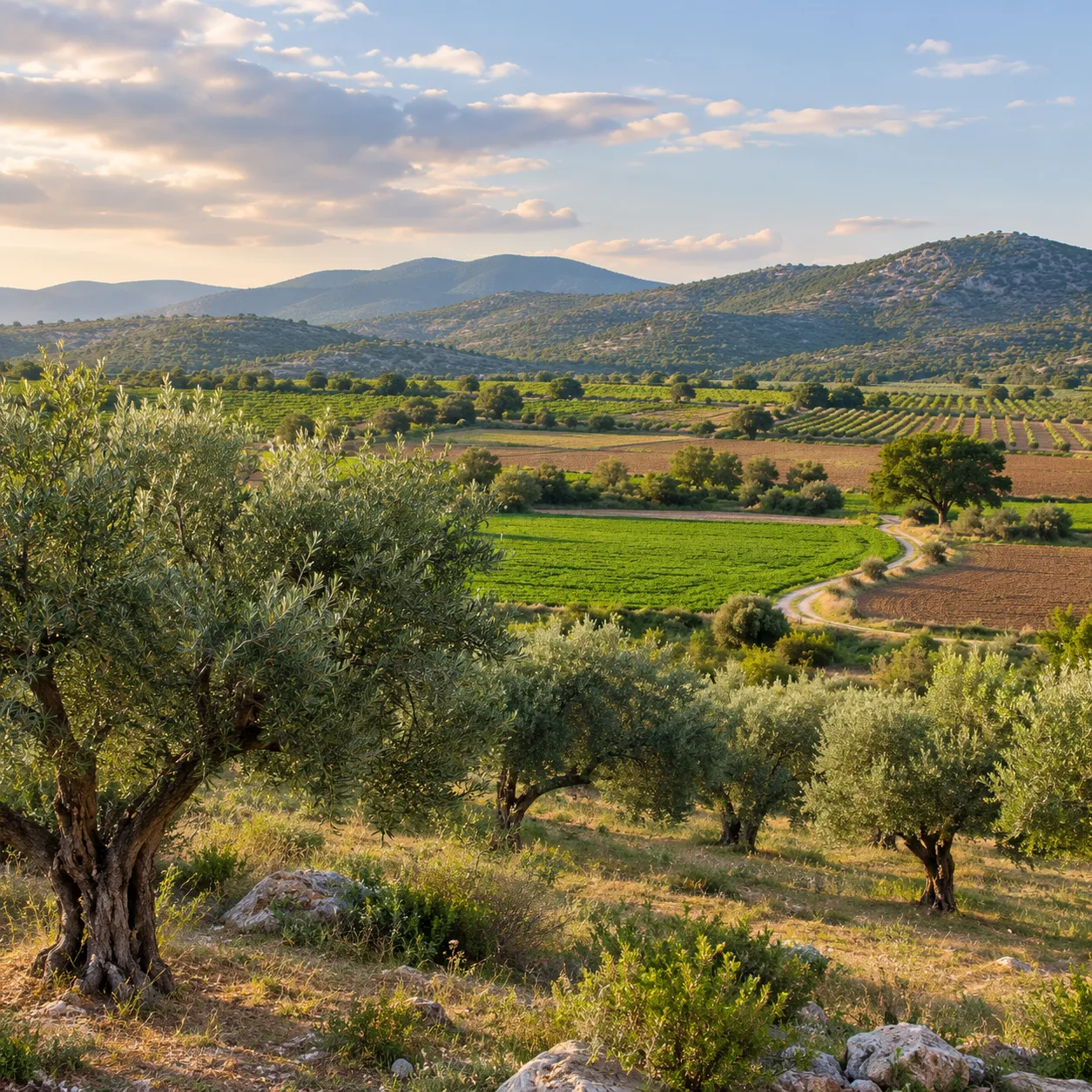
Explore farmland investment in Turkey, from olive groves and working farms to soil, water, running costs and the checks to make before buying.
Choosing the right land means looking beyond its asking price to understand its productive capacity, water resources, legal position and potential future use.
With varied climates, a wide range of crops and a long farming tradition, Turkey offers a choice of agricultural property for domestic and overseas investors.
Olive groves, orchards, arable fields and working farms each involve different investment models. Their productive capacity, cost structure and risk profile can vary considerably.
This guide explores the main considerations when investing in agricultural land in Turkey and how to research opportunities that suit your objectives.
Investing in agricultural land in Turkey
Agricultural production varies significantly between regions. Olives and various fruit crops are prominent in the Aegean region, cereals in Central Anatolia, and citrus and other horticultural crops along the Mediterranean.
This diversity gives investors several possible approaches:
- Earning income from agricultural production
- Acquiring an existing farming business
- Holding productive land over the long term
- Developing an agricultural business to improve efficiency
- Passing a productive property on to future generations
The key is to match the characteristics of the land to the investor's objectives.
Which type of farmland suits your plans?
Olive groves
Olive groves are a notable agricultural asset in the Aegean region. Assessing an investment involves examining the trees' age, variety, health and maintenance history, alongside harvest volumes and irrigation options.
A grove of mature trees should not be assessed with the same income expectations as a newly planted holding.
Orchards and citrus land
For land producing mandarins, oranges and other fruit, climate, irrigation requirements, labour, harvest organisation and access to markets are central considerations.
Alongside the orchard's production history, the budget should account for future maintenance and replanting or renewal.
Arable fields
For wheat, barley and other field crops, soil characteristics, slope, suitability for machinery, rainfall and irrigation infrastructure are decisive.
Particularly on larger holdings, whether the land forms a single unit or consists of scattered parcels can affect operational efficiency.
Working farms
An established farm may include irrigation systems, machinery, storage, agricultural buildings and business records as well as the land.
Such a purchase calls for scrutiny of the business's actual financial and operational position, alongside the property itself.
Why water and soil fertility matter
Acreage alone is not a sufficient basis for comparing agricultural investments.
Two holdings of the same size may have very different prospects: one may benefit from reliable irrigation and fertile soil, while the other depends entirely on seasonal rainfall.
Before buying, investigate the water source, legal rights to use it, continuity of supply, quality and irrigation costs.
Soil structure, drainage, slope and suitability for the intended crop also require specialist assessment.
The presence of a water source does not, by itself, guarantee high yields or investment returns.
How to assess the return on farmland
Agricultural property may have two distinct economic components: changes in the land's market value over time and operating income from farming.
Harvest volume alone is insufficient when assessing production income.
Labour, fertiliser, pruning, irrigation, energy, equipment, transport and marketing costs must also be included.
For an olive grove, for example, maintenance costs and year-to-year fluctuations in yield matter alongside annual output, product quality and selling prices.
Farmland is also not always quick to sell. Your investment horizon and potential need for liquidity should be considered at the outset.
Agricultural land investment in Bodrum and Milas
Bodrum and Milas, in Mugla province, have a long agricultural history and offer land with a variety of characteristics.
Olive groves around Milas are among the options worth investigating for a production-led investment.
However, the region's olive groves are far from uniform.
Main-road access, tree numbers, irrigation, electricity, agricultural buildings and production records can all materially affect the nature of a holding.
At Turnkey Properties, we use our local property experience in Bodrum and Milas to help investors assess different agricultural property options.
Opportunities elsewhere in Turkey can also be researched according to an investor's requirements.
To compare current opportunities, browse our land for sale listings and ask our team about properties suited to your agricultural plans.
What should you check before buying farmland?
The purchase process should include investigations into:
- Title records, ownership structure, shares and registered encumbrances
- The property's official designation and agricultural classification
- Legal road access shown in cadastral records and practical access on site
- Water sources and legal rights of use
- Electricity, irrigation and other infrastructure
- Soil quality and suitability for agricultural production
- Planning permissions and the legal status of existing buildings
- Operating costs and production history
- Restrictions on sale, subdivision and use
- Local market conditions and the investment's liquidity
Turkey's rules on the protection and subdivision of agricultural land fall within the Soil Conservation and Land Use Law No. 5403. The transaction requirements for each property therefore need to be examined individually.
Can foreign investors buy agricultural land in Turkey?
Citizens of eligible countries may acquire agricultural land in Turkey if they meet the applicable legal requirements and obtain the necessary permissions.
Foreign property purchases are subject to specific conditions involving nationality, location, area limits and agricultural use.
The Ministry of Agriculture and Forestry's permission procedures are important for agricultural acquisitions. Purchases of undeveloped property may also involve obligations such as submitting the relevant agricultural project for approval within two years.
Before committing to a purchase, overseas investors should confirm current regulations and the property's specific acquisition requirements with the competent authorities.
Agricultural property advice from Turnkey Properties
We start with the investor and their objectives.
One investor may want an established olive grove, while another is looking for extensive arable land, a citrus orchard or a working farm.
We therefore begin by understanding your budget, investment horizon, production objectives and expectations.
We then help research and compare suitable land and organise the necessary specialist assessments.
Our aim is to combine our local experience in Bodrum and Milas with investment research across Turkey.
Considering an investment in agricultural land in Turkey?
Contact Turnkey Properties to discuss olive groves, fields, orchards or farms suited to your investment objectives.
This article provides general information. It is not a guarantee of investment returns, legal advice or a commitment regarding agricultural yields.
Article information and sources
- Author
- Samet Şahan
- Published
- Updated